Relationships • Self-Worth • Personal Growth
Former People-Pleaser Reveals a 7-Step System That Helps African Women Who Keep Choosing Everyone Else Finally Stop Abandoning Themselves — Without Destroying Their Relationships or Being Called Selfish

Amara Okafor, author of The Last Time You Abandon Yourself
If you have ever stayed in a relationship you knew was wrong for you — and hated yourself for staying — read every word on this page.
If you have ever twisted yourself into shapes you did not recognise just to keep someone comfortable, to keep the peace, to avoid the family drama — this was written for you.
If you have sat across from someone who keeps hurting you and told yourself “maybe I should love them better,” or “maybe if I am more patient, more understanding, more quiet,” — do not close this tab.
If your family tells you to “manage it” because “no relationship is perfect” and you have nodded and swallowed everything down until you cannot taste yourself anymore — you are exactly who this is for.
You wake up and your first thought is about someone else. What they need. What they want. How they are feeling. Whether they are happy with you. Whether you did enough yesterday. Whether you said the wrong thing.
By the time you think about yourself — if you ever get there — there is nothing left.
This cannot be love. I am giving everything and receiving so little back. Why do I keep doing this to myself?
You have heard the advice. Set boundaries. Love yourself first. You cannot pour from an empty cup. You have saved those quotes on Instagram. You have nodded along in church when the pastor speaks about self-worth. You may have even bought a relationship book that lasted two chapters.
But nothing changes. The patterns keep staying. The exhaustion keeps deepening. The relationships keep repeating.
And the worst part is not the loneliness of giving without receiving.
The worst part is what it is doing to you. The woman you used to be before all of this. The dreams you quietly buried. The opinions you stopped sharing. The friendships you let go of. The version of yourself you stopped recognising in the mirror.
You are not weak. You are not broken. You are not “too emotional” or “too difficult” or “too much.”
You just never had permission to choose yourself. And you have been paying for that missing permission ever since.
“I know. Because I carried it too. For almost a decade, I chose everyone else. I chose the man. I chose my family’s expectations. I chose the peace of others over the war inside myself. Until one evening in Peckham, a 63-year-old woman said five words to me that I will never forget.”
My Name Is Amara Okafor.

I am not a therapist. Not a relationship coach with a certificate on the wall. Not a woman whose life has always made sense.
I am just a woman who spent nine years giving herself away — piece by piece — until one day she looked up and could not find herself anywhere.
I grew up in Lagos. Third daughter. The quiet one. The obedient one. The one who never caused trouble, who always understood, who could be counted on to swallow her feelings and carry on. By the time I was 12, I already knew that my job was to keep the atmosphere peaceful. My feelings were secondary. Everyone else’s comfort came first.
I moved to London at 24. Met Emeka at 26. Married at 28 because it was “time,” because my mother’s prayers had been answered, because everyone was happy, because I did not want to disappoint anyone by saying I was not sure.
By year three of the marriage, I had stopped seeing my university friends. By year five, I had stopped pursuing the photography business I had been building before we married. By year seven, I had stopped speaking up in arguments because it was not worth the silence that followed. By year nine, I woke up one morning, looked in the mirror, and genuinely could not tell you who that woman was.
I had disappeared. Not dramatically. Not in one big moment. Slowly. Quietly. One small abandonment at a time.
I tried everything I was told to try. I prayed harder. I became more patient. I went to couples counselling twice — and spent both sessions managing Emeka’s feelings instead of speaking my own truth. I read books about communication and love languages. I listened to podcasts about marriage. I spoke to my pastor’s wife who told me the problem was my expectations.
None of it worked. Because none of it addressed the real problem. Which was not Emeka. Which was not the marriage. Which was the fact that I had never learned how to stay in the same room as myself.
The pattern went deeper than the marriage. It was in every relationship I had ever had. It was in how I related to my mother. To my sisters. To my friends. To my colleagues. Wherever I went, I put myself last. And I called that love.
I did not know — not then — that the reason I kept ending up in the same exhaustion, the same resentment, the same feeling of invisible suffocation — was not because of the people around me. It was because I had never been shown how to choose myself. Not even once.
The Evening That Changed My Entire Life Forever
It was a Tuesday evening in November. Our women’s fellowship at Redeemed Christian Church, Peckham.
Every third Tuesday, the women gathered. A small group — maybe twenty-five of us. We prayed, we shared, we encouraged each other. Some weeks I left feeling lighter. Most weeks I left feeling like I was carrying something I had no name for.
That particular Tuesday, I almost did not go. I had had another one of those conversations with Emeka. The kind where I said something real, something I had been holding for weeks, and he looked at me like I was speaking a language he had no interest in learning. I went to bed in the spare room. I cried into the pillow for a while. Then I got up, put on my coat, and went to fellowship because I needed somewhere to be that was not inside my own chest.
There is a woman in our fellowship. Mama Josephine. She is 63 years old. Born in Owerri. Widowed at 55. Spent 25 years in a marriage where, as she put it, she was physically present and spiritually absent. She is short, compact, with eyes that seem to already know the answer before you finish asking the question. The kind of woman who does not waste words.
That evening, after prayers, I sat near the door, staring at my phone. Reading nothing. Just needing somewhere for my eyes to go.
I did not notice her until she sat down next to me.
She did not ask how I was doing. She did not make small talk. She simply sat there beside me for a moment. And then she asked one question.
“How long have you been disappearing?”
Something inside me cracked open.
Not disappeared. Disappearing. Present tense. As if she could see it happening right now, in real time, while I sat there with my coat still on and my eyes too bright and my jaw held just a little too tight.
I had never said it out loud to anyone. That I was fading. That despite the job, the marriage, the flat in South London, the WhatsApp status updates and the church attendance and the Friday night zooms with friends — I was hollow. That I could not remember the last time I had done something just because I wanted to. That I had not chosen myself, even in a small way, in so long that I would not have known what choosing myself even looked like.
I have never been more seen and more terrified in the same breath as I was in that moment on that plastic chair in that church hall in Peckham.
The Discovery That Changed Everything
Mama Josephine did not look sorry for me. She did not offer me tissue or a hug or sympathy. She just nodded very slowly. The nod of someone who has been where you are and survived it.
Then she said the five words.
“You have abandoned yourself, my daughter.”
I started crying. Not the polite kind. The real kind. Nine years of careful, quiet disappearing coming out at once, in a church hall in Peckham, in front of a 63-year-old woman who was not even slightly surprised.
She handed me a small handkerchief. She waited. Then she began to speak.
She spoke for almost two hours. I barely moved.
The Big Idea — Why Everything You Have Tried Has Failed
Here is the truth that no relationship book, no Instagram therapist, no church counsellor, no family advice will tell you:
Your relationship problem is not a love problem. It is a self-abandonment problem.
When you have been conditioned since childhood to erase yourself for others — to call it sacrifice, to call it obedience, to call it love — you do not know how to stop. The behaviour has become automatic. Unconscious. You abandon yourself before anyone even asks you to. You shrink pre-emptively. You apologise for taking up space. You feel guilty for having needs.
The solution is not to love them better. It is not to be more patient. It is not to wait for them to change. The solution is to understand the exact mechanism of your self-abandonment — when it started, what it looks like in your specific life, and how to dismantle it step by step without blowing up every relationship you have.
Once you see the pattern clearly, you cannot unsee it. And once you cannot unsee it, you can finally begin to do something different.
I sat with that for a very long moment. Running the calculation in my head. All the years. All the versions of myself I had quietly set aside for other people’s comfort. All the times I had told myself: this is just what love looks like. This is just who I am. Next time I will speak up. And never did.
It took one woman, on two plastic chairs near a church window on a Tuesday night in November, to name what had actually been happening.
She then walked me through a seven-step process. Each step was specific. Each step built on the last. It was not complicated. It did not require years of therapy or the courage to burn everything down. It was built precisely for women like us — raised in cultures where self-sacrifice is expected, where family approval is oxygen, where choosing yourself feels like the most selfish act in the world — and shows you, step by step, how to come back to yourself without losing everyone you love in the process.
The First Week: Nothing Dramatic
I went home that night and wrote down everything Mama Josephine had told me. Three pages. Front and back. The handwriting was uneven because my hands were still shaking slightly.
I started the first step the next morning. Not with a grand gesture. Not with a confrontation. With something small. Something so small it felt almost ridiculous.
I made myself a proper breakfast. Sat at the table. And ate it slowly, without my phone, without scrolling, without planning anyone else’s day. Just me. Sitting. Eating. Present.
It took eleven minutes. I cried for three of them. Because I could not remember the last time I had done something just for myself and not felt guilty about it while doing it.
Day 2. I said no to a WhatsApp message from my sister-in-law asking me to help with something I had no capacity for. I typed the no. Deleted it. Typed it again. Sent it. Then sat with the guilt for twenty minutes.
The guilt was enormous. Like I had committed a crime.
But I did not call back. I did not take it back. I just sat with the guilt. And it passed.
That was the first time I understood what Mama Josephine meant when she said the guilt is not a sign you did wrong. It is a sign you did something new.
Day 5: The First Sign
I had a conversation with Emeka I had been avoiding for four months. Not an argument. A real conversation. I said what I actually thought. In a calm voice. Without softening it into something I did not mean just to watch his reaction.
He went quiet.
I did not rush to fill the silence. I did not immediately apologise. I just let the words exist.
The conversation did not resolve anything that night. But something had shifted. Not in him. In me. I had spoken my truth and not immediately taken it back. That had never happened before.
Day 10. Day 15. Then Something Broke Open.
By Day 10, I had had two honest conversations I would previously have avoided. I had said no three times to people I loved without launching into long explanations. I had spent two evenings doing something I wanted to do — without performing gratitude for the permission to do it.
By Day 15, the guilt was still there. But it was quieter. Like it was losing a volume war it had always previously won.
By Day 21, something Emeka said to me — something that previously would have sent me spiralling for three days — landed differently. Not because he had changed. Because I had. I heard it, I felt it, and I let it go. I did not absorb it. I did not carry it. I did not let it rewrite my sense of myself.
That was new. That was entirely new.
I had spent nine years absorbing every criticism, every silence, every withdrawal of warmth as evidence that I was not enough. That if I was just a little better, a little quieter, a little more patient — things would be okay. And on Day 21, for the first time, something did not stick to me that used to stick. I shook it off. And went back to myself. For the first time in nine years, I had something to go back to.
The Night My Husband Looked at Me Differently
End of month one. A Sunday evening. We sat down for dinner — which had become a quiet, careful meal in our house. The kind where both people are present and no one is there.
I had stopped performing ease. I had stopped filling silences with anxious chatter designed to manage the atmosphere. I had stopped trying to make things comfortable at the cost of making myself invisible.
And Emeka — without warning — looked at me across the table and said something I had not expected.
“You seem different.”
Not better. Not worse. Just: different.
I said, “I am.”
And I meant it in a way I did not fully have words for yet.
He sat back and looked at me in a way he had not looked at me in years. Not with warmth exactly. But with a kind of attention. Like he was seeing something he had not seen in a long time and was not quite sure what to do with it.
I did not know, when I started this process, whether it would save my marriage or end it. What I knew by the end of month one was this: for the first time in nine years, I recognised myself. And whatever happened next — whether Emeka grew alongside me or whether we eventually had to face harder truths — I was not going to lose myself again. Not for him. Not for anyone. That was the shift. Not a dramatic decision. Just a quiet, settled, completely non-negotiable knowing: I was staying. In my own life. In my own body. In my own truth. This time.
I Did Not Plan to Tell Anyone
Three months after that Tuesday evening, I went back to Mama Josephine after fellowship. I told her what had happened. The conversations I had finally had. The things I had stopped doing. The things I had started doing. The way I recognised myself now in a way I could not have imagined when she first sat next to me.
She listened and smiled. Not a surprised smile. The smile of someone who already knew.
A friend called me that same week, crying. Same story. Slightly different man, slightly different family, completely identical exhaustion. She had been people-pleasing and self-abandoning for so long she did not know who she was outside of being useful to other people.
I sent her everything Mama Josephine had taught me.
She sent me a voice note three weeks later. She could not get through it without stopping. I played it four times.
She sent it to her cousin in Nairobi. Her cousin sent it to a group chat in Johannesburg. From WhatsApp to WhatsApp, woman to woman, the framework quietly spread.
Here is what they told me:
Adaeze M., 34
“I have spent my whole adult life being the ‘understanding one.’ The one who never complains. The one who manages. I did not even realise I was abandoning myself because I had made it look like virtue. This guide named something I had been living but could not describe. Three weeks in and I had my first conversation with my mother where I said what I actually felt. I wept afterwards. Not from sadness. From relief.”
Akosua B., 29
“I kept going back to a man I knew was not right for me. Six times. I hated myself every time. I thought the problem was that I loved him too much. This guide showed me the real problem: I loved myself too little. By chapter four I understood myself in a way I never had. I have not gone back since. It has been five months. I feel like I am meeting myself for the first time.”
Ngozi A., 42
“I am Igbo. I was raised to be selfless. My mother called it being a good woman. I called it love. This guide showed me it was neither. It was conditioning. The Guilt-Free Boundary Blueprint alone changed how I interact with my entire family. My mother called me last month and said she does not know what happened to me. I told her: I found myself. She was quiet for a long time. Then she said, ‘good.’”
Wanjiru K., 37
“I was in a relationship for four years that I knew was wrong after year one. I stayed because I was scared of being alone. Because of what people would say. Because my family loved him. This guide gave me the clarity framework I had been desperately looking for. I could not find it in any book or podcast because none of them were written for someone in my specific situation — African, family pressure, cultural weight, real stakes. This one was. I finally chose myself. I am not sorry.”
Thandi M., 39
“I am a lawyer. I argue for a living. And yet when it came to my own life — my own needs, my own voice — I was completely silent. The section on rebuilding your identity after disappearing hit me so hard I had to put the guide down and sit with it for two days. I am not the same woman who started reading this. I am glad I am not.”
Fatima D., 45
“I help people for a living. And I had no idea how to help myself. I had been so busy being strong for everyone — clients, children, husband, family back home — that I forgot I was also a person who needed something. The 30-Day Come Back to Yourself Protocol in this guide brought me back in ways I did not know I had left. I recommend it to every woman I know.”
Same framework. Same steps. Same return to self.
Why I Am Sharing This
Six months after that Tuesday evening, I went back to Mama Josephine again. I told her everything. The conversations. The changes. The ways I was still learning. The friends I had already passed the framework to and the voice notes they had sent back.
She listened without interrupting. Then she was quiet for a long moment.
I asked her if I could write it all down. Document exactly what she had shown me. Make it available to the women who needed it and had no Mama Josephine sitting next to them on a plastic chair on a Tuesday night.
She looked at me steadily.
I spent the next five months writing. Refining every step. Testing every exercise with women across West Africa, East Africa, Southern Africa, and the diaspora. Women at different life stages — single, married, divorced, widowed, mothers, daughters, career women, full-time homemakers. The principles held across every situation. The exercises worked. The framework survived contact with real lives.
Now Available
The Last Time You Abandon Yourself
The African Woman’s Guide to Stopping the Self-Erasure, Setting Boundaries Without Guilt, and Finally Choosing Herself
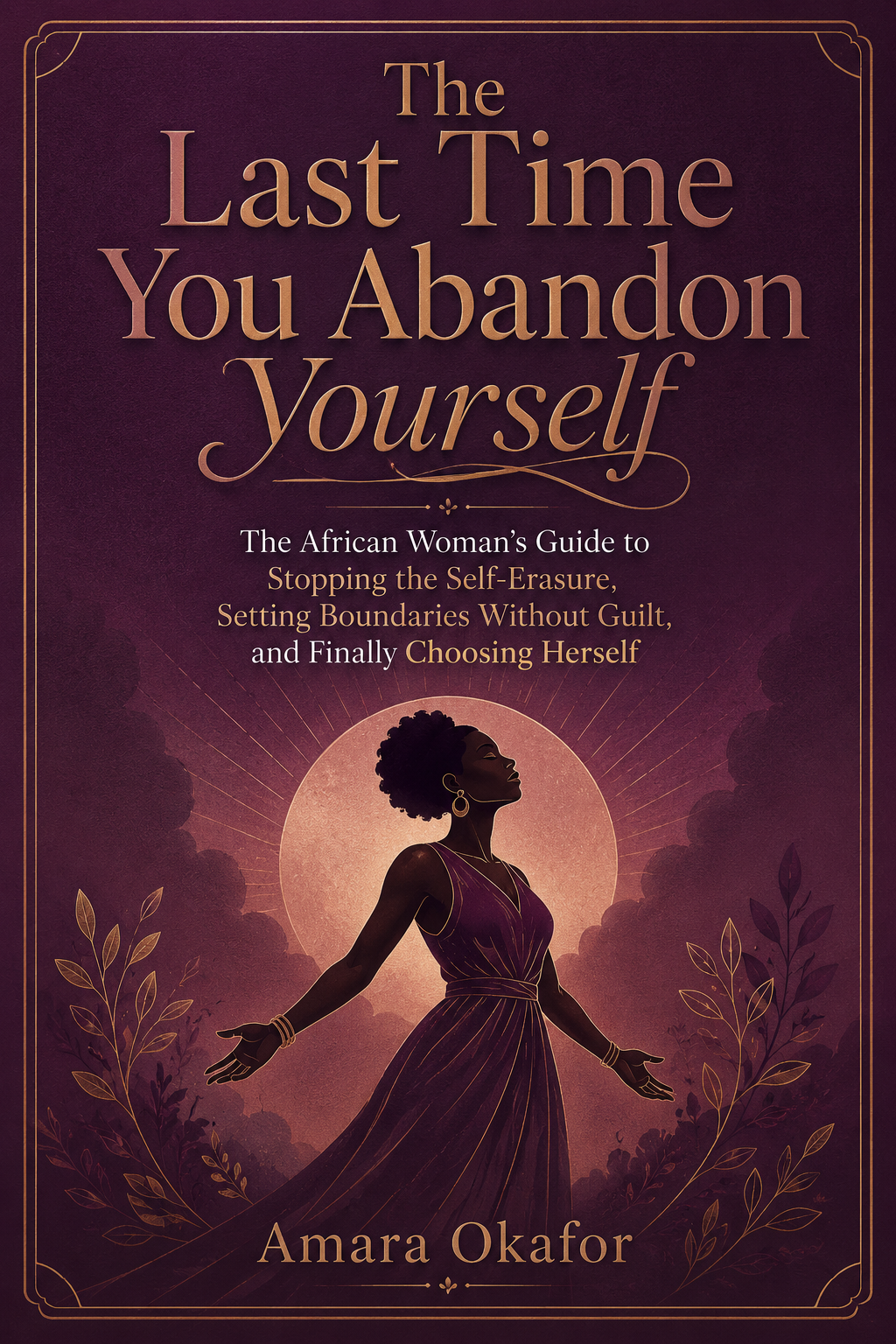
Everything Mama Josephine taught me — documented, structured, refined, and written in plain language so you can begin applying it from today. Built specifically for African women carrying the weight of cultural expectations, family pressure, and a lifetime of being told that choosing yourself is the same as being selfish.
- The Anatomy of Self-Abandonment — How African cultural conditioning trains women to disappear for everyone else’s comfort from childhood. Includes the Self-Abandonment Origin Map: the exact exercise that shows you when it started and what it has been costing you ever since. (Pg. 12)
- The People-Pleasing Trap — Why being “the strong one,” “the understanding partner,” “the good daughter” is quietly destroying you from the inside. The hidden cost of performing okayness. How to tell the difference between genuine generosity and compulsive self-erasure. (Pg. 26)
- The Guilt-Free Boundary Blueprint — How to set boundaries with partners, parents, in-laws, and friends without being labelled “too Western,” “difficult,” or “selfish.” Built specifically for African family dynamics, including how to hold a boundary when the whole family is pushing against it. (Pg. 38)
- The “Should I Stay or Should I Go?” Clarity Framework — The step-by-step decision-making system for women who know something is deeply wrong but cannot seem to choose themselves. Includes the Relationship Reality Audit and the Five Questions That Cut Through Every Justification You Have Ever Made. (Pg. 54)
- Rebuilding Your Identity After the Disappearing — How to rediscover who you are when you have spent years being whoever everyone else needed you to be. What to do when you have forgotten your own preferences, opinions, and dreams. Includes the Identity Archaeology Exercise. (Pg. 68)
- The Self-Abandonment Detox: 30-Day Protocol — A structured daily practice for breaking the automatic habit of putting yourself last. Includes daily micro-boundaries, journaling prompts, and the weekly Self-Check-In so you can see yourself changing in real time. (Pg. 78)
- The New Story: Living as a Woman Who Chooses Herself — How to build a life, a relationship, and a family dynamic where you never have to disappear again. What choosing yourself actually looks like on an ordinary Tuesday when no one is watching. (Pg. 90)
You do not need to leave your relationship to start this. You do not need your family’s permission. You do not need to be at rock bottom. Everything in this guide can be started tonight, in the life you are already living, from exactly where you are right now.
Compare That to What You Have Already Tried
✗ Therapy sessions: ₦15,000–₦50,000 per session in Lagos alone. Four sessions minimum before you even begin to touch the real patterns. Most women cannot afford to go consistently — so they go twice, feel better briefly, and the patterns return.
✗ Western self-help books: ₦5,000–₦12,000. Written for women in New York or London who live alone, have no family obligations, and whose mother does not call about grandchildren every Sunday. Completely irrelevant to your actual life.
✗ Instagram therapists and life coaches: ₦20,000–₦150,000 for courses and coaching programs. Generic frameworks. Beautiful slides. Nothing specific to the cultural weight, family dynamics, and relationship patterns of African women.
✗ Women’s retreats and workshops: ₦25,000–₦200,000. Three days of breakthroughs and then back to the same house, the same people, the same dynamics — with no structured follow-through.
✗ Church counselling: Often free. And often the advice is to pray more, submit more, and wait for things to change. With the best of intentions, it frequently reinforces the exact patterns that are making you disappear.
The real cost — the one nobody puts a number on: The years you have spent shrinking. The dreams you quietly buried. The version of yourself you stopped protecting. The relationships you have had where you gave everything and left with nothing. The mornings you woke up and could not recognise yourself. The slow erosion of your sense of who you are and what you are worth.
How Much Does This Guide Cost?
Before I tell you the price, let me tell you what it cost me to create it.
| ICP research & in-depth interviews with women across Africa and diaspora | ₦35,000 |
| Professional writer & editor (5 months of development) | ₦55,000 |
| Testing & refinement across women in Nigeria, Ghana, Kenya, South Africa, UK & Canada | ₦28,000 |
| Design & PDF formatting | ₦18,000 |
| Website, hosting & tech setup | ₦8,000 |
| Total invested | ₦145,000 |
A fair price for this framework would easily be ₦145,000. One therapy session in Lagos costs more than what I am charging for this entire guide. One hour with a relationship coach who has not lived what you have lived costs more than this.
I am not going to charge you ₦145,000. Not ₦50,000. Not ₦25,000. Not even ₦15,000.
The original price was set at ₦12,500. But because you are reading this today — and because this offer is only for the first 100 women who act — you are not paying ₦12,500 either.
Your Price Today (First 100 Buyers Only)
₦12,500 ₦5,000⚠ This price is only guaranteed for the first 100 buyers. Once the counter fills, the price returns to ₦12,500.
Once You Click That Button, Here Is What Happens
- Step 1 — Payment Page: You are taken instantly to a secure payment page. Pay by card, bank transfer, or USSD — whatever is easiest for you.
- Step 2 — Complete Payment: Payment is processed securely and automatically by the platform.
- Step 3 — Instant Delivery: Within 60–90 seconds of payment confirmation, your guide and all three bonuses are delivered directly to your WhatsApp and email. No waiting. No manual sending.
It is me, Amara. As long as your payment is confirmed, your access is 100% guaranteed.
What Happens in the First 7–30 Days
Real conversations. Real women. Real returns to self.
72 women have already secured their copy at this discounted price — only 28 spots remaining at ₦5,000.
Bear in mind, you are not the only one viewing this page right now.
Click Here to Secure Your Copy NOW →WAIT — I Have Something Special For You…
If you are among the first 100 buyers, you will receive these three powerful bonus guides alongside your main guide — at zero extra cost.
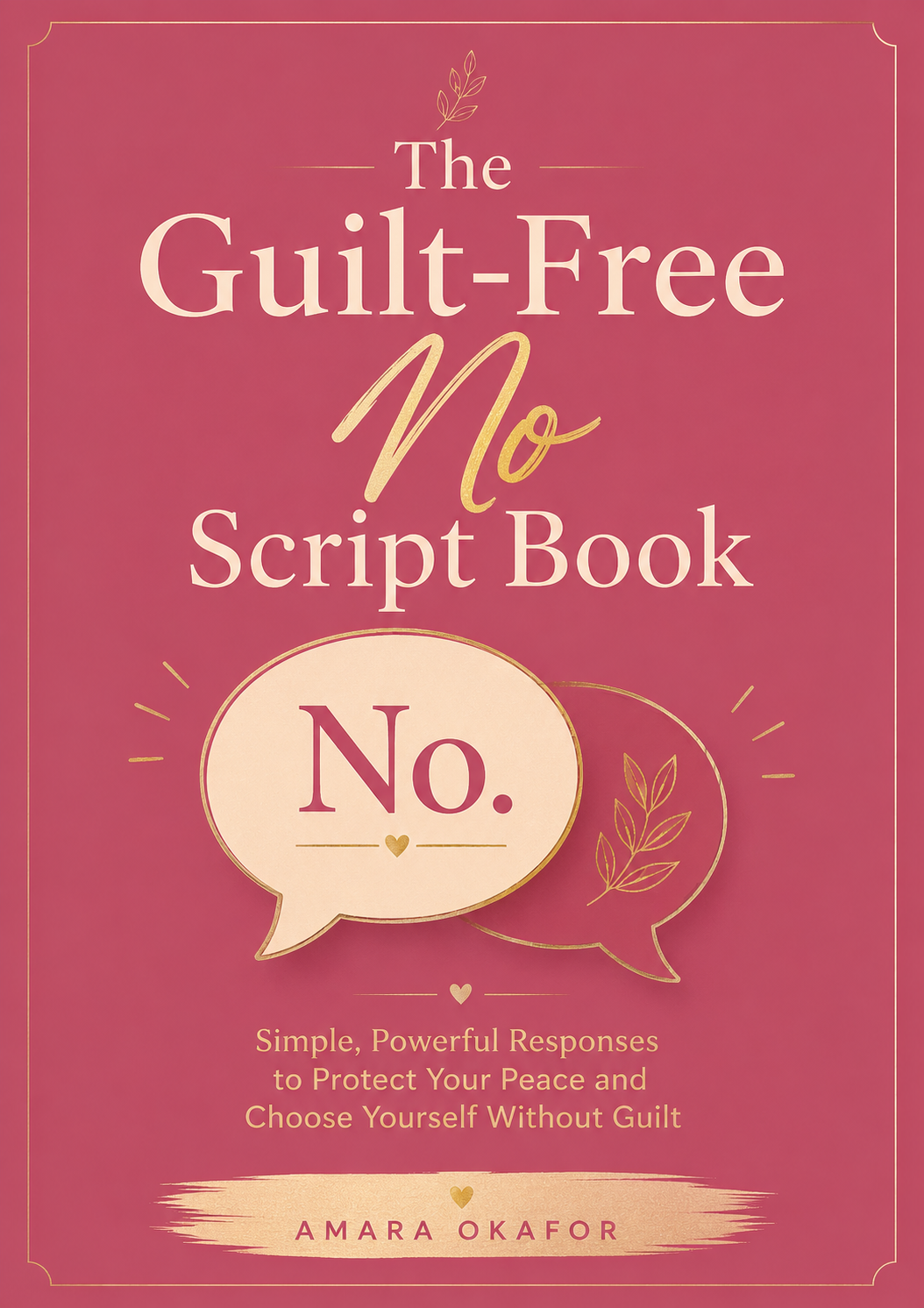
BONUS 1
The Guilt-Free No Script Book
Value: ₦8,000 — FREE today
The #1 reason women stay stuck in self-abandonment is that they do not know what to say when they try to choose themselves. Every attempt to set a limit is met with guilt, manipulation, tears, or family drama — and they fold. This bonus gives you the exact word-for-word scripts for the twenty most common situations African women face: your mother pressuring you about marriage, your in-laws overstepping, a partner guilt-tripping you, a friend making unreasonable demands, extended family expecting money you do not have, and the moment someone tells you that you are being “too Western” for having needs. What to say. How to say it. What to do when they push back. Written specifically for Nigerian, Ghanaian, Kenyan, South African, and diaspora cultural contexts.
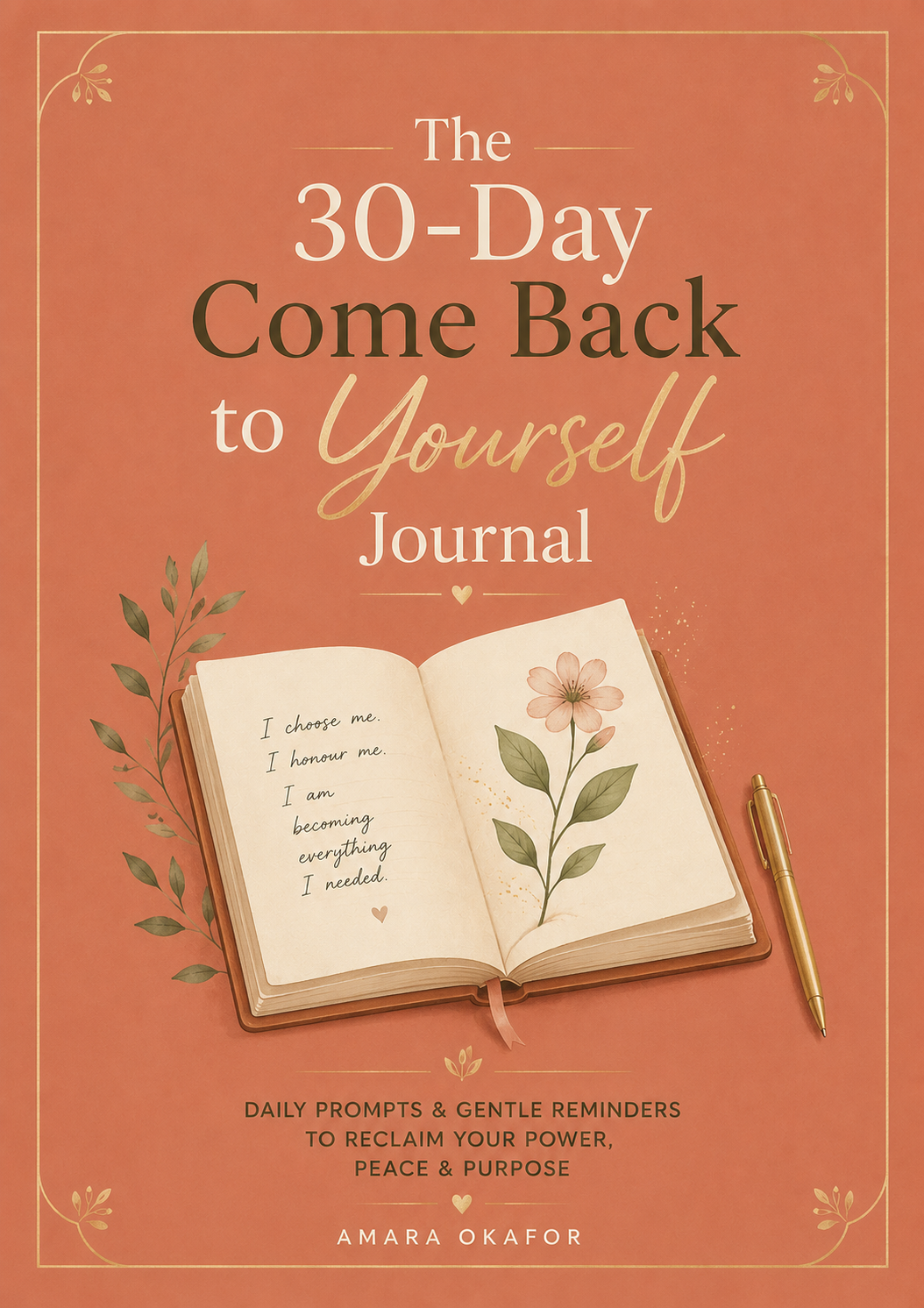
BONUS 2
The 30-Day Come Back to Yourself Journal
Value: ₦6,500 — FREE today
If you have spent years being whoever everyone else needed you to be, you may not even know what you like anymore. Your preferences. Your opinions. Your dreams. They have been buried under a decade of managing other people’s feelings. This 30-day guided journaling workbook walks you back to yourself, one prompt at a time. Includes: the “Who was I before I started shrinking?” deep-dive exercise, daily identity prompts that take 10 minutes a day, the weekly “What did I do just for me this week?” audit, and the Resentment Mapping exercise that shows you exactly where your self-abandonment is most active in your daily life. Designed for African women who have been strong for so long they have forgotten they are also soft.
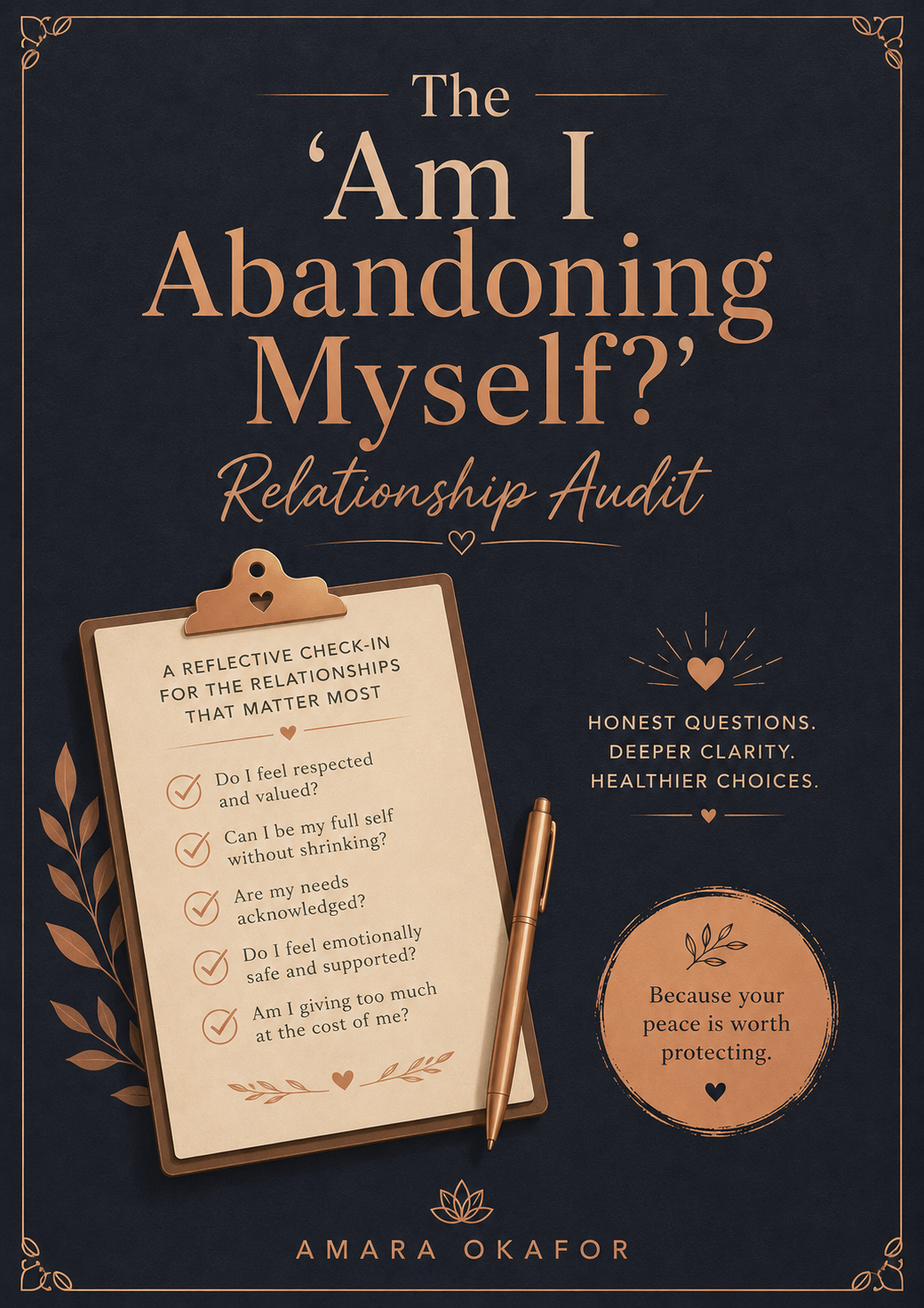
BONUS 3
The “Am I Abandoning Myself?” Relationship Audit
Value: ₦5,000 — FREE today
Before you can stop abandoning yourself, you need to see clearly where and how you are doing it right now. This deep diagnostic guide shows you exactly that. Includes the Self-Abandonment Patterns Checklist (47 specific behaviours to look for), the Energy Audit Tool (who in your life takes more than they give and by how much), the Resentment Inventory (the single most accurate indicator of where your limits need to be), and the One Question That Will Tell You Everything About Whether You Are Choosing Yourself or Performing That You Are. Designed to be completed in one evening. The results will be uncomfortable. They will also be the most clarifying thing you have read about your own patterns.
Everything You Are Getting Today
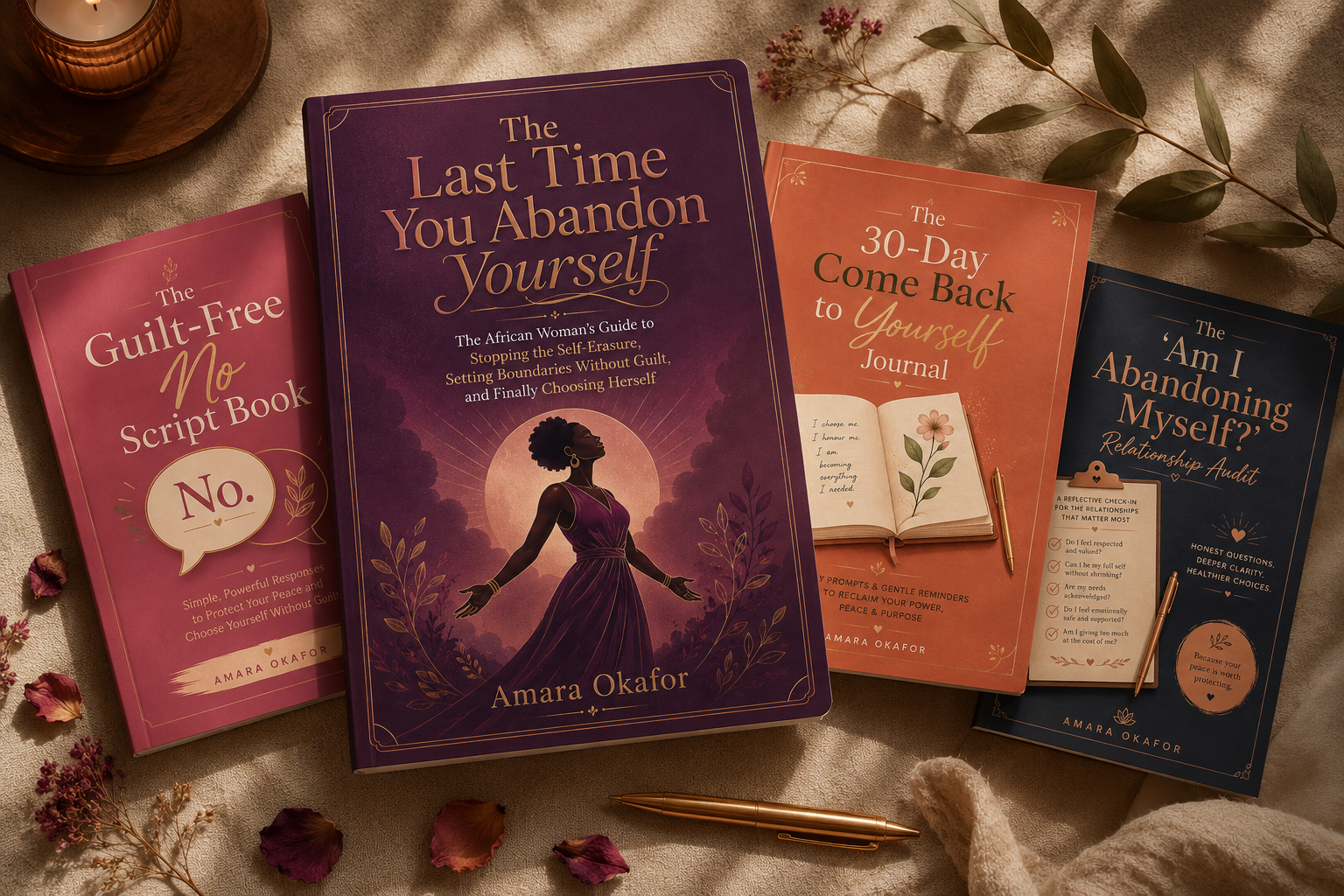
- The Last Time You Abandon Yourself (Main Guide — ~100 pages)
₦12,500 - BONUS 1: The Guilt-Free No Script Book
₦8,000 - BONUS 2: The 30-Day Come Back to Yourself Journal
₦6,500 - BONUS 3: The “Am I Abandoning Myself?” Relationship Audit
₦5,000
Total Value: ₦32,000
You Pay Today: ₦5,000
YES — I Am Ready to Choose Myself →Right Now, You Have Two Choices
✗ Do Nothing
- The same patterns continue
- You keep shrinking to keep the peace
- The resentment keeps building quietly
- You wake up in five years still unrecognisable to yourself
- You keep wondering when it will finally be your turn
✓ Choose Yourself Today
- You finally see your patterns clearly
- You have the exact words for every difficult moment
- The guilt loses its grip, step by step
- You come back to a self you actually recognise
- You stop waiting for permission and give it to yourself
The Last Time You Abandon Yourself + 3 Powerful Bonuses
₦12,500 ₦5,000One-time payment • Instant delivery to WhatsApp & Email • First 100 buyers only
✓ 30-Day Money-Back Guarantee
Read the guide. Do the exercises. Spend 30 days with the framework. If you see no shift whatsoever in how you relate to yourself and the people around you, I will refund every naira. No interrogation. No long emails. No drama. Your purchase today is completely risk-free.
The only real risk is closing this page and staying exactly where you are.
One Last Thing…
Picture yourself one month from today. A difficult moment comes — a conversation that would previously have sent you shrinking, a demand that would have made you fold, a silence that would have made you desperate to fix it. And instead of disappearing, you stay. Present. In yourself. Grounded. Knowing what you think and feel and need, and being able to hold it without immediately giving it away.
Will you finally have a conversation you have been swallowing for years?
Will you say no to something that has been draining you and not immediately take it back?
Will you look in the mirror and recognise the woman looking back for the first time in a long time?
Will you feel the guilt and choose yourself anyway because you finally understand that the guilt is not a signal that you are wrong — it is just proof that you are doing something new?
Now picture yourself one month from today if you close this page. Everything stays the same. The same shrinking. The same swallowing. The same quiet resentment building under the surface. The same wondering when it will be your turn.
The difference between those two versions of you is a decision you make in the next sixty seconds.
If you have read this far and you are still hesitating —
Ask yourself honestly: is it that you do not believe this framework works? Or is it that a part of you does not believe you deserve for it to work for you?
You have been telling yourself the story that you are just “this kind of person” — the one who gives, the one who manages, the one who puts everyone else first — for so long that part of you is afraid to find out it was never true. That it was always a pattern. That you were always allowed to choose yourself. That the permission was always yours to give.
If you cannot invest ₦5,000 in coming back to yourself — in the woman underneath all the sacrifice and all the silence and all the careful disappearing — ask yourself what that says about how much you believe your own life is worth fighting for.
Stop waiting. Choose yourself. This is what that looks like.
P.S. — Your purchase is fully protected by a 30-day money-back guarantee. Follow the framework for 30 days. Do the exercises honestly. If nothing shifts, I refund every naira. You have nothing to lose and a completely different relationship with yourself to gain.
P.P.S. — This ₦5,000 price is only for the first 100 buyers. Once those spots are filled — and they are filling quickly — the price returns to ₦12,500 and the three bonuses are removed. The moment to act is right now.
P.P.P.S. — Every day you wait is another day you spend choosing everyone else. Another day of swallowing what you actually feel. Another day of postponing yourself. The guide is ready. The bonuses are waiting. You do not need anyone’s permission to begin. You only need your own.
With love and full permission for your return,
Amara Okafor
Frequently Asked Questions
How is the guide delivered after I pay?
Does this work if I am not sure whether to stay or leave my relationship?
Does this work for women outside Nigeria — Ghana, Kenya, South Africa, diaspora?
What if I am not in a romantic relationship? Will this still apply to me?
Is the 30-day guarantee real? What if I want a refund?
How is this different from the relationship books and self-help content I have already tried?
Get The Last Time You Abandon Yourself Now →
This page is editorial content. Results shared are real testimonials from actual readers. Individual results will vary based on personal circumstances, consistency of application, and willingness to engage with the exercises. This guide is for informational and educational purposes only and is not a substitute for professional mental health care. © 2026 She Chose Herself Blog. All rights reserved.
Comments (2,341)
Chioma Eze
Abuja, Nigeria • 1 day ago
“I know I should leave but I can’t.” That sentence from one of the Reddit posts referenced in this article is literally my entire life for the past three years. Just bought the guide. Will return. 🙏
♥ Like (387)Abena Asante
Kumasi, Ghana • 3 days ago
The part about how we learn self-abandonment as little girls — from our homes, from our culture, from being praised for being “good” and quiet and never asking for too much — hit me so hard. I am 31 and this is the first time anyone has explained why I am the way I am. And given me a way out.
♥ Like (261)Taiwo Babatunde
Lagos, Nigeria • 5 days ago
A man reading this and I am not ashamed. I realised through this guide that I have been abandoning myself for years too — in friendships, in my relationship, in my family dynamics. Self-abandonment does not only happen to women. Thank you for writing this.
♥ Like (198)Wambui Njoroge
Nairobi, Kenya • 1 week ago
The “Should I Stay or Should I Go?” Clarity Framework is something I have been searching for for two years. Every article I read either told me to stay (“marriages take work”) or to leave (“you deserve better”). No one gave me a framework for actually thinking through it clearly, without my fear or guilt doing the thinking for me. This guide does that. Extraordinary.
♥ Like (314)Nolwazi Dlamini
Cape Town, South Africa • 1 week ago
South African here. Read this in one sitting. The section on how cultural conditioning is mistaken for personality — “that is just who I am” when it is actually what you were taught to survive — is something I will be thinking about for the rest of my life. Everything I thought was my character. It was my conditioning. I am 36 and I am meeting myself for the first time.
♥ Like (276)Bisi Okonkwo
London, UK (Nigerian Diaspora) • 2 weeks ago
When you are in the diaspora, the guilt is doubled. You feel guilty for being here while everyone is there. You feel guilty for having more. You feel guilty for wanting a life that is just yours. So you over-give, over-send, over-accommodate, over-everything. Until you are empty. This guide understood that specifically. I did not expect that. I wept reading Chapter 2. Good weeping.
♥ Like (342)Adaeze Obi-Nwosu
Sydney, Australia (Nigerian Diaspora) • 3 weeks ago
Reading from Sydney. The Guilt-Free No Script Book bonus alone is worth ten times the price of the whole bundle. I have been rehearsing conversations with my mother in the shower for years and then saying nothing when the moment comes. Having actual scripts — written for our specific cultural dynamics — is something I have never seen anywhere else. Immediately useful. Thank you Amara.
♥ Like (229)